

Crunches
A Crunch is the protocol’s foundational unit of organization: a targeted prediction challenge with clear rules, inputs, and desired outputs. Each Crunch:- Locks Rewards: An escrowed USDC pool funds successful participants.
- Sets Rules: Coordinators need to comply with the Crunch rules, including evaluation criteria, duration, and payout schedule.
- Enforces Quality: Models are continuously evaluated against real-world outcomes and secondary metrics such as latency and stability.
- Sets Constraints: Models must respect limits defined by the Coordinator node — e.g., maximum GPU time, RAM, external-resource access, and minimum performance.
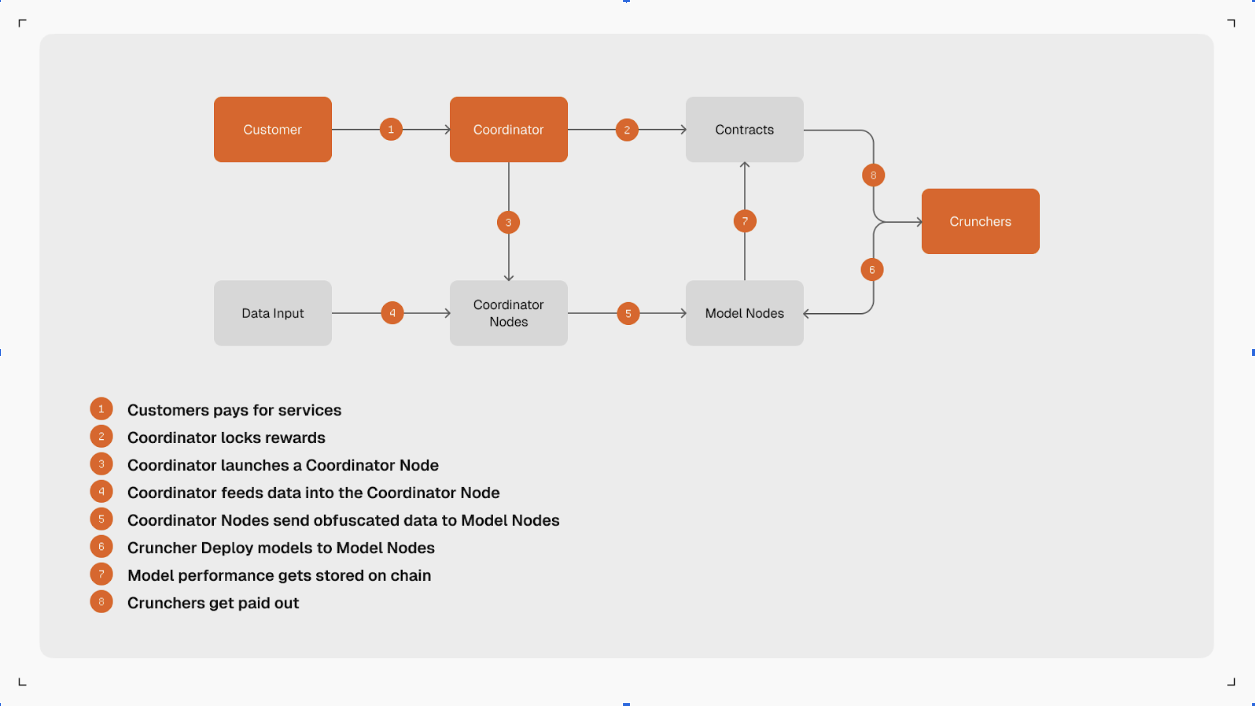
High Level Overview of a Crunch Workflow
Architecture Overview
The Crunch Protocol leverages multiple on-chain contracts and off-chain nodes to support the network at scale, with high throughput and low latency.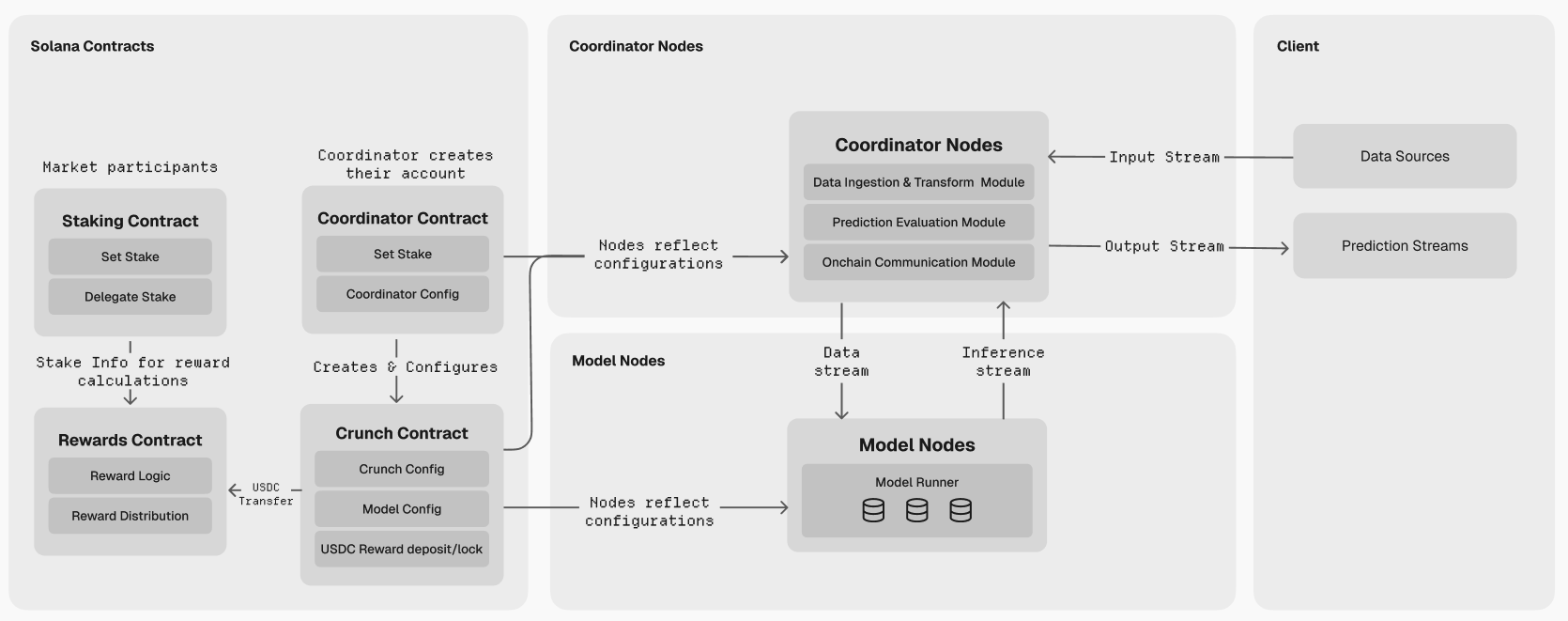
High Level Overview of the Crunch Protocol
Coordinator Contract
Allows domain-expert teams to create a Coordinator account, register their nodes, and seek on-chain approval.- Account creation: Creation of a Coordinator account on the protocol.
- Approval: If basic requirements, like minimum staking and team mission, are met, a Coordinator is approved by governance and can then start interacting with Model Nodes through Crunches.
Coordinator Nodes
Coordinator Nodes handle the off-chain orchestration of data flow in and out of the protocol. We provide out-of-the-box modules for three key functionalities, State Mirroring, Scorekeeping, and communication with Model Nodes, alongside the ability to add custom features as needed. Coordinator nodes are performing:- Data Ingestion: Collect external data from various sources.
- Data Transformation: Obfuscate, transform, augment, anonymize or otherwise modify the raw data to help participants, apply PETs, maintain privacy, then provide it to Model Nodes.
- Evaluate contributions and determine performance rewards by means of rank-based systems using accuracy metrics, or other mechanisms that are inspired by markets or statistics.
- Performance summarization that will typically take the form of leaderboards and performance metrics of various kinds. Synchronizing with the Crunch Contract and storing of results on IPFS.
- State Mirroring: Tied to a valid Coordinator Contract account, the node tracks Crunch participants, triggers evaluations, and updates on-chain records.
Crunch Contract
- Creation and Management: Defines the overall rules (e.g., Crunch duration, model type constraints) and escrows USDC for rewards.
- Model Submissions: When Crunchers upload their model, the protocol deploys it to the Model Nodes. Subsequently the Coordinator Nodes can provide the data stream to the model and evaluate the predictions.
- Payout Logic: At checkpoints or upon completion, the Crunch Contract calls a reward function to pay out Crunchers, then notifies the Staking Contract to calculate staking rewards.
Model Nodes
Model Nodes can be provisioned globally and serve as the execution environment for models participating in a Crunch, exposing an interface for streamlined prediction requests. They run any model participating in a crunch, ensuring that only Coordinator Nodes with appropriate privileges can call the model or access their outputs. Responsibility of the Model Nodes:- Dynamic Model Management: Listen for state changes from the Crunch Contract. Models start or stop automatically based on which Crunches are live and models being added or removed.
- Inference Submission: Forward live predictions to the Coordinator Nodes for evaluation.