> ## Documentation Index
> Fetch the complete documentation index at: https://protocol.crunchdao.com/llms.txt
> Use this file to discover all available pages before exploring further.
# Data Security and Model Protection
> How the Crunch Protocol protects submitted models and Coordinator data using TEE, MPC, and other privacy-preserving techniques.
Protecting model intellectual property and Coordinator data is a core requirement of the protocol.
Crunchers need confidence that their model code stays private. Coordinators need assurance that
sensitive data is handled securely.
The Crunch Protocol addresses this through a layered security approach:
* **Network-level** — the [Secure Model Protocol](/core-concepts/access-control) encrypts all
communication and authenticates both parties via mTLS and on-chain identity
* **Execution-level** — models run in isolated containers with no direct code access; only
API-based inference is exposed
* **Hardware-level** — Trusted Execution Environments (TEE) and Multi-Party Computation (MPC)
provide additional guarantees for the most sensitive use cases
## Trusted Execution Environments (TEE)
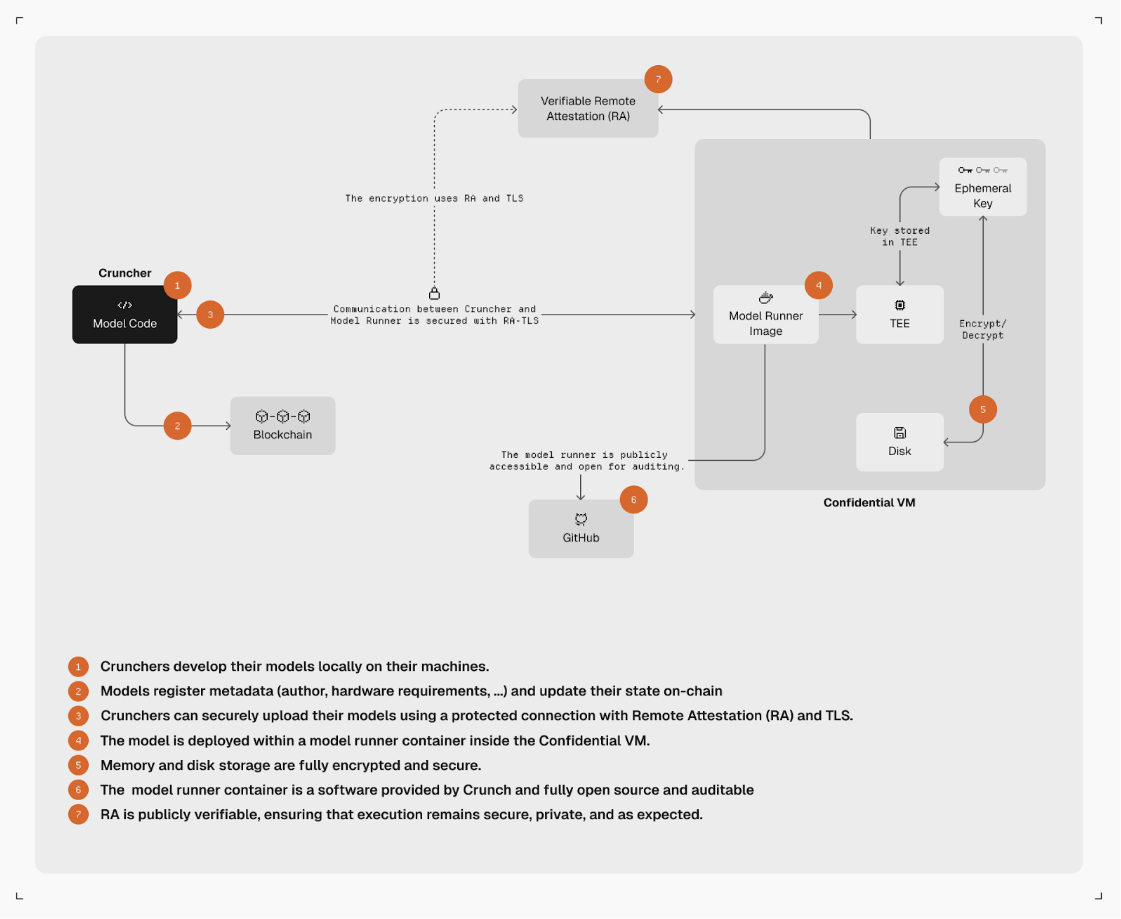
In cooperation with [Phala Network](https://phala.network), Model Runners can run inside Trusted
Execution Environments. TEEs provide hardware-enforced isolation — even the infrastructure operator
cannot inspect the model code or data inside the enclave.
This ensures:
* Model code is encrypted at rest and in transit
* Inference happens inside a tamper-proof enclave
* The Coordinator can verify the enclave's integrity via remote attestation
 ## Multi-Party Computation (MPC)
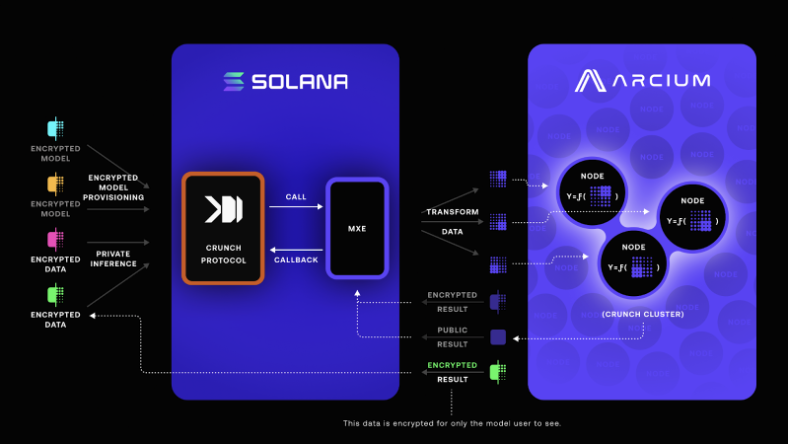
In cooperation with [Arcium](http://arcium.com/), the protocol is exploring Multi-Party Computation
for scenarios where even the model runner should not see the full input data. MPC splits
computation across multiple parties so that no single party has access to both the model and the
data in cleartext.
This is particularly relevant for:
* Competitions using proprietary enterprise data
* Healthcare and financial use cases with regulatory requirements
* Scenarios where Coordinators want to protect raw data from model authors
## Multi-Party Computation (MPC)
In cooperation with [Arcium](http://arcium.com/), the protocol is exploring Multi-Party Computation
for scenarios where even the model runner should not see the full input data. MPC splits
computation across multiple parties so that no single party has access to both the model and the
data in cleartext.
This is particularly relevant for:
* Competitions using proprietary enterprise data
* Healthcare and financial use cases with regulatory requirements
* Scenarios where Coordinators want to protect raw data from model authors
 Where participants discover and join your competition.